
LLMs
LLMs
The large language models that matter, one section each: Claude, GPT, Gemini, Grok, Llama, Nemotron, Amazon Bedrock and Nova, DeepSeek, Qwen, Mistral and other open models, with their newest releases, results, prices and how to use them.
Nothing matches. Try another word.
November 2026 25
Meta's Muse family for developers: Ember, Spark Open weights, Glimmer and API pricesA developer guide to Meta's Muse models after Llama: Muse Ember at $0.10 input, open Muse Spark Open and Glimmer weights, licences, prices and how to call them.Read →GLM-5.4 explained: Z.ai's first looped flagship, its hybrid KV cache and what is confirmedZ.ai's GLM-5.4 runs GLM-5 layers twice for more depth at the same size. How looping, gated updates and the hybrid KV cache work, and what is still unconfirmed.Read →Gemma 4 in late 2026: five sizes, Apache 2.0, EmbeddingGemma 2 and how to choose oneA practical guide to Google's Gemma 4 open models: E2B to 31B, the 12B Unified model, memory needs, Apache 2.0 terms, EmbeddingGemma 2 and how to run each one.Read →Claude and the Riemann hypothesis claim: what a Lean-checked proof does and does not proveAn Anthropic mathematician says Claude helped prove the Riemann hypothesis in Lean. How proof checking works, what is verified so far and the Claude line-up.Read →Extending context windows with RoPE scaling: position interpolation, NTK, YaRN and Llama 3How rotary position embeddings encode position, why models fail past their training length, and how linear, NTK, YaRN and Llama 3 scaling stretch context.Read →Qwen4-Max arrives: Alibaba's new flagship, its prices and how it fits beside open Qwen3.8Alibaba launched Qwen4-Max on 16 November 2026 at $1.50 and $4.50 per million tokens with a 1M context. How it compares with Qwen3.8 and how to use each model.Read →How open models reach 1M tokens: Kimi K3, GLM-5.3-Flash and MiniMax-M3 comparedKimi K3, GLM-5.3-Flash and MiniMax-M3 offer open weights and 1M-token context with different attention designs. How each works, what it costs, how to pick.Read →NVIDIA Nemotron in late 2026: Ultra, Super, Lightning and Transcribe, and how to chooseA guide to NVIDIA's open Nemotron models: sizes, context, licences, hosted prices, maker-reported scores and how hybrid Mamba, MoE and MTP fit together.Read →Mistral Large 4 three weeks on: a 1T open-weight model at $0.70 and the full Mistral line-upMistral Large 4 is a 1T-parameter mixture-of-experts model with open weights and 1M context at $0.70 per million input tokens. How it compares with Medium 3.5.Read →Llama in late 2026: what Llama 4 still offers, its licence terms and how to run itA guide to Meta's Llama models as Meta shifts to Muse: Llama 4 Scout and Maverick specs, maker-reported benchmarks, licence limits, hosted prices and setup.Read →Grok API in late 2026: Grok 4.7, custom guidelines, safety identifiers and long-context pricesA guide to xAI's Grok API in November 2026: the Grok 4.x line-up, prices above 200K tokens, the guidelines and safety_identifier fields and a gated cyber mode.Read →GPT Live 1.1, delegation to GPT-6.2 and 8-hour background windows in the OpenAI APIOpenAI added gpt-live-1.1, MCP servers for Live sessions and 2-hour and 8-hour background windows. How the voice-to-backend split works and what it costs.Read →Gemini 4 Hydrogen, xhigh thinking and google-genai 3: what changed for Gemini API developersGoogle's Gemini SDK moved to v1 and httpx2 and added Gemini 4 Hydrogen, an xhigh thinking level and Live Interactions. A guide to line-up, prices and migration.Read →DeepSeek in late 2026: V4 Pro, V4.1 Flash, sparse attention kernels and off-peak pricingA guide to DeepSeek V4 Pro and V4.1 Flash: API prices with off-peak discounts, 1M context, DeepSeek Sparse Attention and why FlashMLA dropped Hopper GPUs.Read →Claude Fable 5.2 and Mythos 5.2 two weeks on: the Claude line-up, prices and API changesA practical guide to the November 2026 Claude line-up: Fable 5.2, Mythos 5.2, Opus, Sonnet and Haiku 5.5, their prices, 1M context and recent SDK changes.Read →Amazon Bedrock adds projects and Trusted Access Programs: what changes, plus the Nova line-upBedrock now scopes model calls to projects, adds Trusted Access Programs and retention settings, and AgentCore agents can pay via AWS Billing. Plus Nova prices.Read →How Inkling 2 Mini fits a looped 26.4B mixture-of-experts model on a laptopThinking Machines released Inkling 2 Mini, an open-weights 26.4B MoE model. How looped layers, expert pruning and 4-bit NVFP4 training let it run on a laptop.Read →Gemini 4 Neon explained: model tiers, thinking levels, cached input and orchestrator agentsGoogle's Gemini 4 Neon sits between Carbon and Hydrogen. Learn how model tiers, thinking levels, 95% cached input and orchestrator subagents shape cost.Read →What RL on expert-built tasks teaches Nemotron 3.5 Super, one LoRA adapter at a timeA new paper trains five rank-32 LoRA adapters on Nemotron 3.5 Super with CISPO and no SFT. We explain the method, the 12 benchmark gains and the failure modes.Read →GPT-6.2 Astra and Sol: what changed, what it really costs and how to pick a tierOpenAI's GPT-6.2 Astra and Sol cut frontier prices and tokens per task. How to read the benchmarks, cached-input pricing, Ultrafast, and which tier to route to.Read →Gemini 4 Carbon tops MathArena: how to read scores, costs and intervals on a math leaderboardGemini 4 Carbon leads MathArena at 85.4%, but the top three overlap and costs differ 15-fold. How IRT, four runs, fresh problems and Lean shape the ranking.Read →llama.cpp reaches 1.0: how GGUF, quantization, ggml backends and llama-server fit togetherllama.cpp and ggml hit v1.0.0 with a semver promise, a speech endpoint and a hardened server. Learn how GGUF, quantization, backends and the KV cache work.Read →Revolut, AMD and Mistral show coding agents moving to self-hosted open-weight modelsRevolut, AMD and Mistral point coding agents towards self-hosted open-weight models. How the serving stack, routing, evals, licences and the cost maths work.Read →Kimi K3.1 Pro and ERNIE 5.5 Flash Base: sizing giant open MoE modelsMoonshot and Baidu published very large mixture-of-experts weights this week. Here is how MoE works, what the licences allow, and how much memory hosting needs.Read →GPT-6 Cyber, Tencent Hy4 and DeepMind's RSA work on AI bug huntingOpenAI, Tencent and Google DeepMind all shipped security-focused AI work this week. What happened, how AI bug hunting works, and what defenders should do now.Read →
01Simulations 11
Interactive simulations of how language models work inside: change the settings and watch every step.
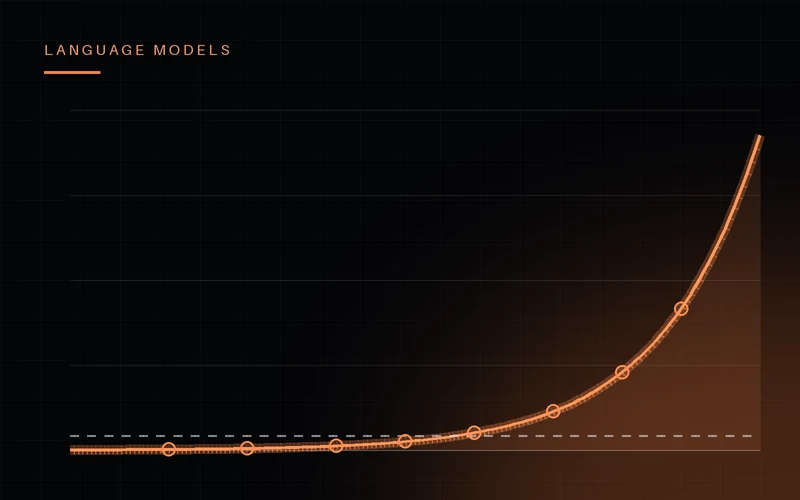 Softmax temperature and min-p: how a language model picks its next wordSee how temperature reshapes a language model's next-token probabilities and how min-p sampling trims the tail, with entropy and every token computed live.Open simulation →
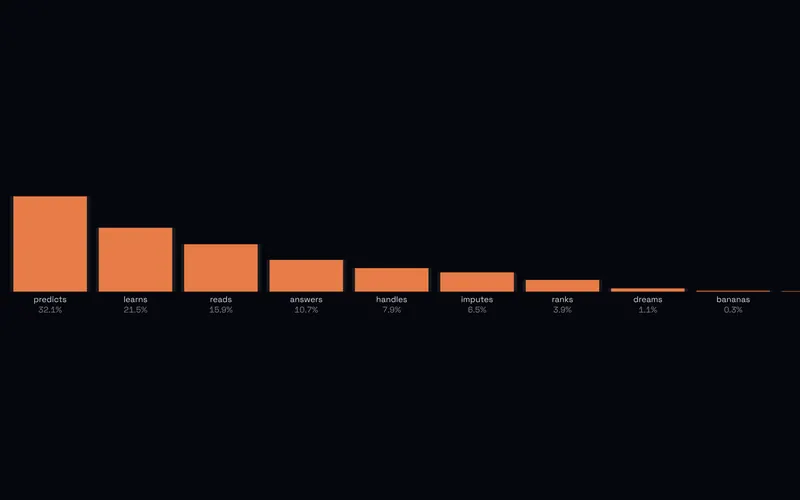 Sampling: temperature, top-k and top-pSee how a language model picks the next word: temperature, top-k and top-p reshape the probabilities, and 200 samples show what comes out.Open simulation →
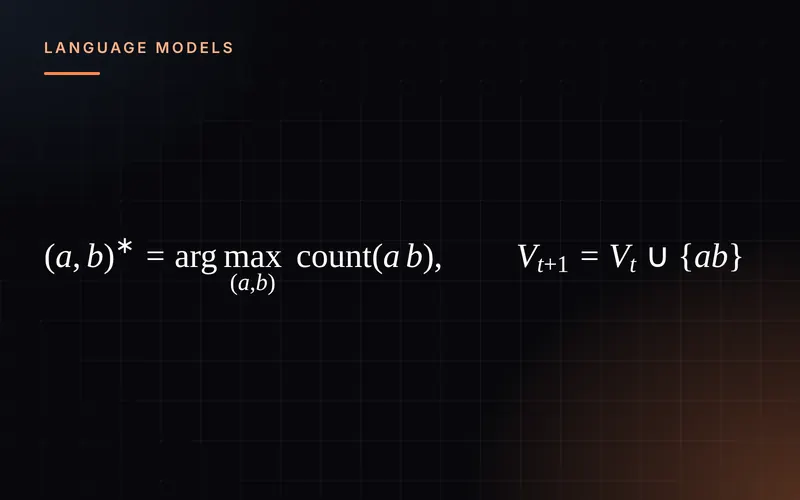 Tokenisation with byte-pair encoding, merge by mergeSee how a tokeniser is trained: byte-pair encoding counts adjacent pairs and merges the most frequent one, building a vocabulary step by step.Open simulation →
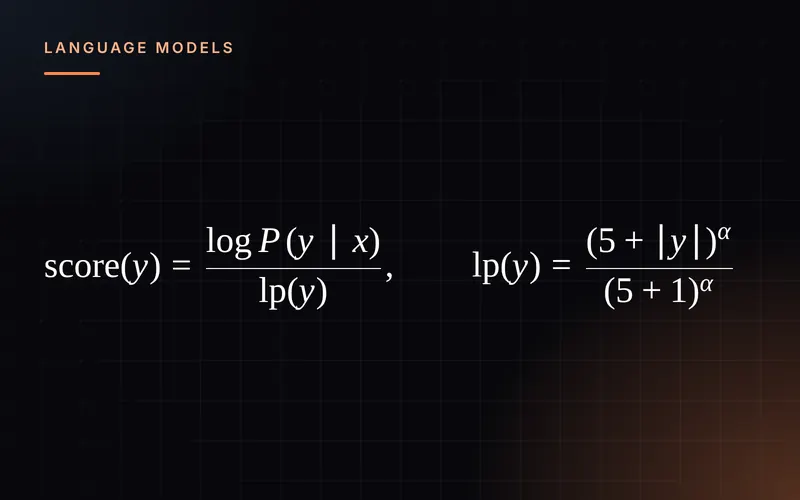 Greedy decoding vs beam search, with length penaltyWatch greedy decoding and beam search expand a small language model step by step, find a more probable sentence, and change with the length penalty.Open simulation →
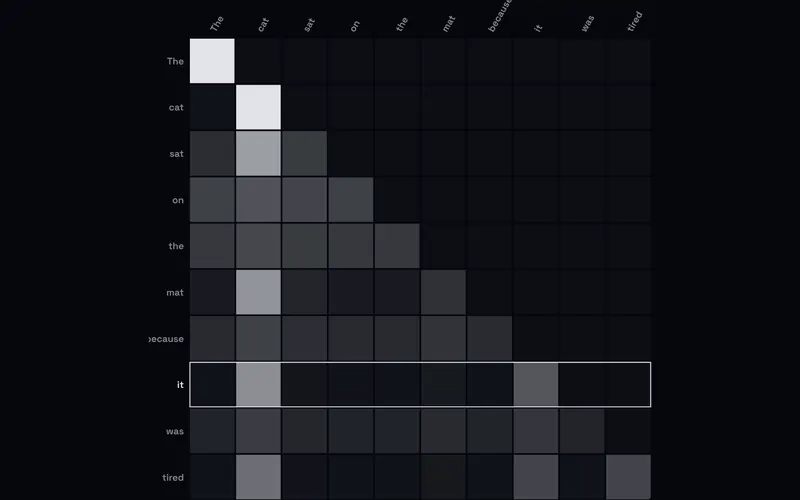 Attention: how a transformer decides what to look atSee self-attention weights for a sentence: queries, keys, softmax and temperature, three heads and a causal mask, all interactive.Open simulation →
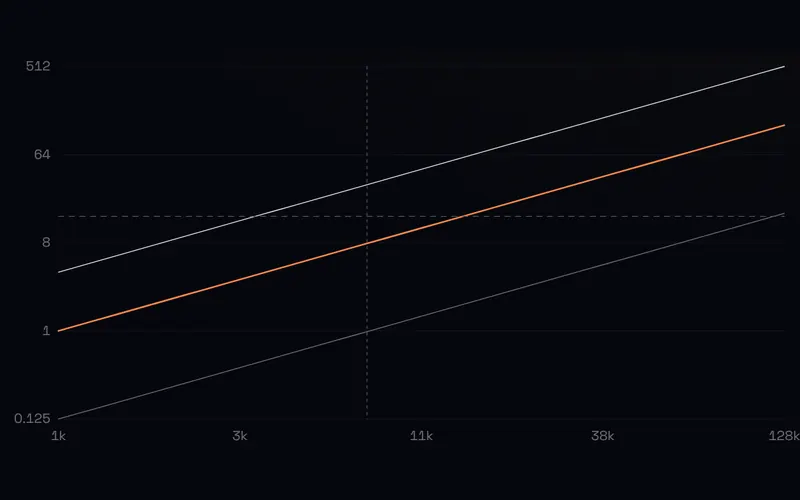 The KV cache: why generation needs it and what it costsSize the KV cache of 1B, 8B and 70B-class models across context length and batch, compare MHA, GQA and MQA, and watch decoding reuse cached keys and values.Open simulation →
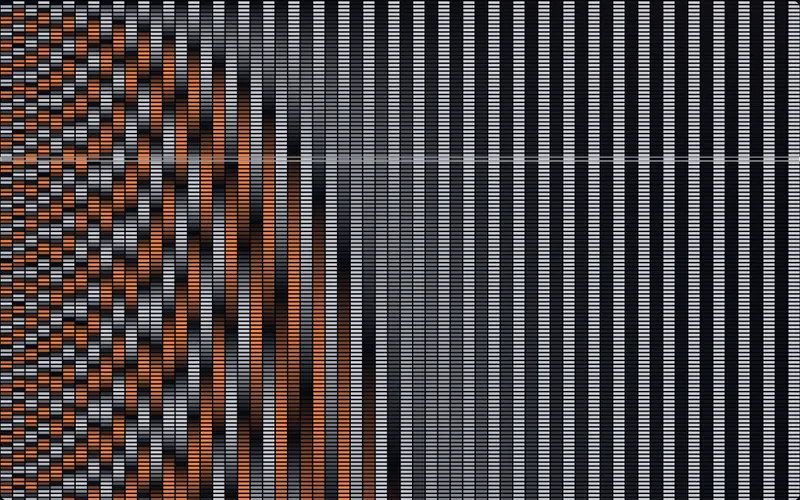 Positional encoding: sinusoids and rotary embeddings (RoPE)See how transformers know word order: the sinusoidal encoding matrix, its similarity by distance, and RoPE rotating queries and keys so scores depend on m − n.Open simulation →
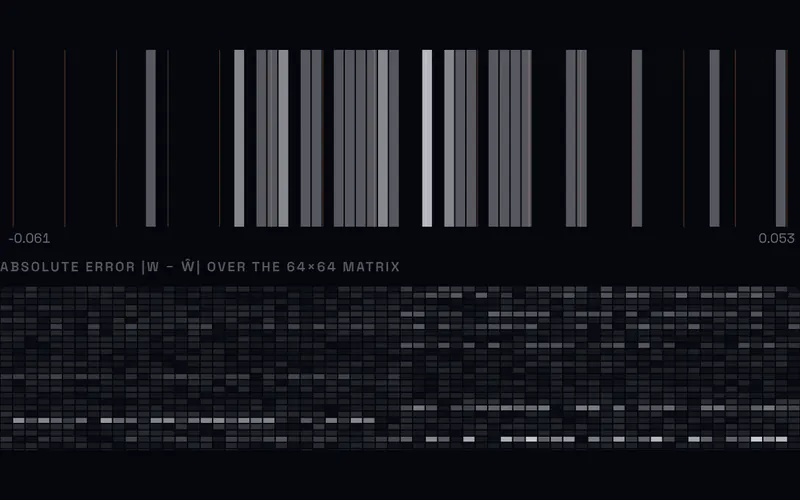 Quantisation: 8, 4 and 2 bits, scales, groups and outliersQuantise a real weight matrix to 8, 6, 4, 3 or 2 bits with per-tensor, per-channel or group scales and see the error, the effect of outliers and the memory.Open simulation →
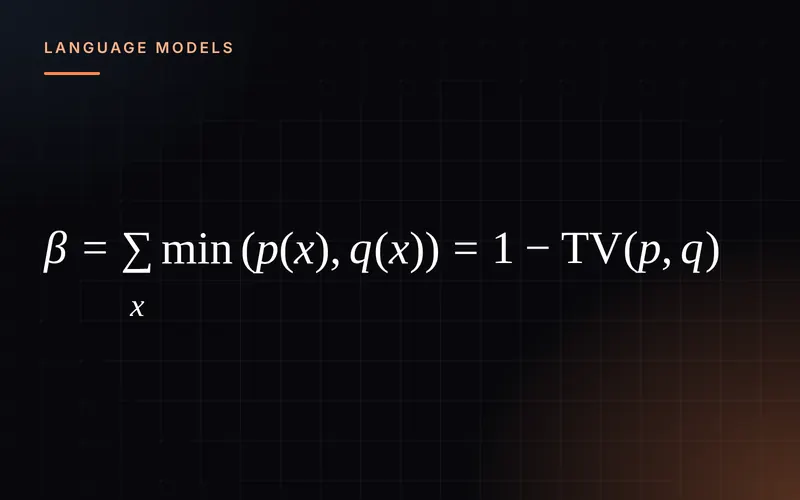 Speculative decoding: a small model drafts, the large model verifiesA draft model guesses k tokens, the large model verifies them in one pass: acceptance rate, speed-up and a check that the output distribution is unchanged.Open simulation →
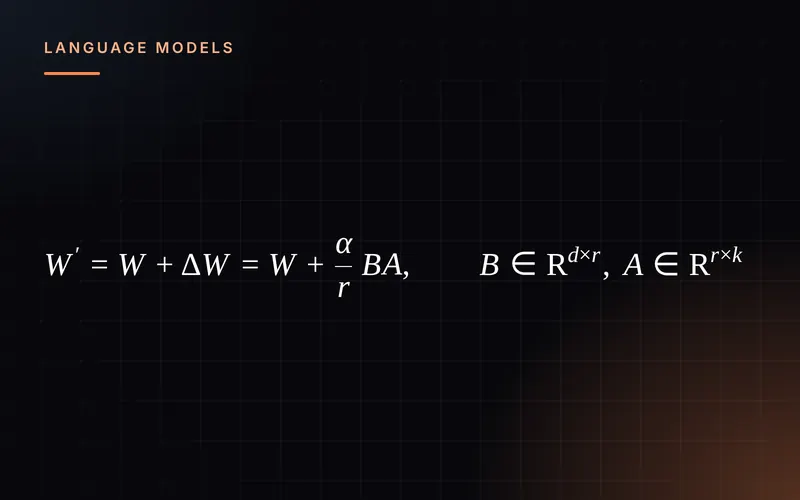 LoRA: fine-tuning with a low-rank updateTrain LoRA's A and B matrices to fit an update of known rank, compare with the SVD optimum, and count trainable parameters for real model sizes.Open simulation →
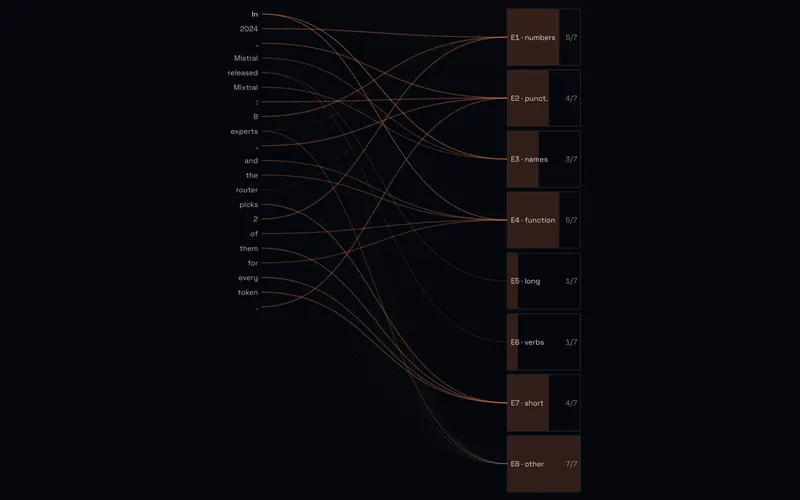 Mixture of experts: routing tokens with top-k gatesType a sentence and watch a router send each token to its top-k experts, with capacity limits, dropped tokens and the load-balancing loss.Open simulation →